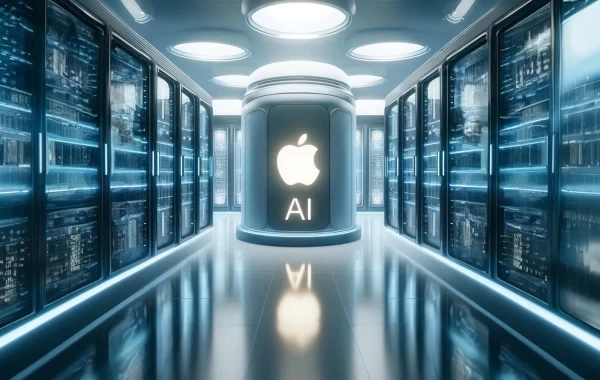
Apple Eyes AI Chip Acquisitions to Build Faster Apple Intelligence Servers
-

- by THEFLGHT,
- July 19, 2026
- in Artificial-Intelligence
Apple is reportedly exploring the acquisition of artificial intelligence chip companies as it accelerates work on the next generation of Apple Intelligence infrastructure. According to reports, the company has approached several semiconductor startups and financial advisers to evaluate potential deals that could strengthen its ability to design high-performance processors specifically for artificial intelligence workloads. The move signals Apple's determination to become less dependent on third-party AI hardware while expanding its own ecosystem of custom silicon for future AI services.
The reported acquisition strategy comes as Apple continues investing heavily in AI despite entering the race later than competitors such as Microsoft, Google, Meta, and OpenAI. While Apple has successfully integrated Apple Intelligence across iPhone, iPad, and Mac devices, many of its advanced cloud-based AI services still require powerful server infrastructure.
Reports indicate that Apple has encountered delays with its internally developed AI server processor, known by the codename Baltra, prompting the company to explore acquisitions that could accelerate development and improve performance.
Artificial intelligence has dramatically changed the semiconductor industry over the past two years. Training and operating large language models requires enormous computing power, creating unprecedented demand for specialized AI processors capable of handling trillions of calculations every day.
Nvidia currently dominates this market with its advanced GPUs, but nearly every major technology company is now investing in custom AI chips to reduce costs, improve efficiency, and gain greater control over their AI platforms. Apple's reported acquisition plans reflect this broader industry trend toward vertically integrated AI infrastructure.
One reason Apple is pursuing custom AI hardware is efficiency. Unlike general-purpose processors, AI-specific chips can be optimized for machine learning, natural language processing, image generation, and voice recognition while consuming significantly less power. Apple has already demonstrated the benefits of custom silicon through its M-series processors, which transformed the performance of Mac computers. Industry observers believe the company hopes to achieve similar advantages for its cloud-based AI systems by designing processors tailored specifically for Apple Intelligence workloads.
Strengthening Apple's server infrastructure could also improve future versions of Siri and other AI-powered features across the company's ecosystem. As Apple Intelligence expands to handle increasingly sophisticated tasks, including advanced reasoning, personalized assistance, real-time translation, and creative content generation, demand for faster server-side processing will continue growing. Better AI chips would allow Apple to deliver more capable features while maintaining the privacy and security standards that have become central to its brand identity.
The semiconductor market has become one of the most competitive sectors in technology.
Alongside Nvidia, companies such as AMD, Intel, Qualcomm, Broadcom, Amazon, Microsoft, and Google are investing billions of dollars in AI hardware development. Rather than relying entirely on external suppliers, Apple appears determined to strengthen its own engineering capabilities through strategic acquisitions and internal chip design. Analysts believe this approach could give Apple greater flexibility as AI becomes an increasingly important part of every product it sells.
For investors, the reported acquisition discussions highlight Apple's long-term commitment to artificial intelligence. Instead of focusing solely on software features, the company is investing in the underlying hardware that powers AI services behind the scenes. Owning more of the technology stack—from custom chips to operating systems and consumer devices—could help Apple deliver faster innovation while reducing operational costs over the coming years.
Although Apple has not officially confirmed any acquisition plans, the reports suggest the company is preparing for a future where artificial intelligence depends as much on specialized hardware as it does on advanced software. As competition intensifies across the global AI industry, Apple's efforts to strengthen its chip technology could play a decisive role in the evolution of Apple Intelligence and the company's ability to compete with the world's leading AI platforms.





0 Comments:
Leave a Reply