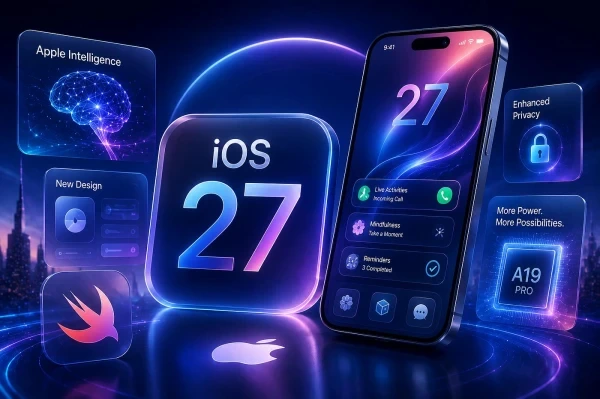
Apple Opens AI-Powered Siri to Millions of iPhone Users With iOS 27 Public Beta
-

- by THEFLGHT,
- July 21, 2026
- in Artificial-Intelligence
Apple has taken a major step in its artificial intelligence strategy by opening the redesigned AI-powered Siri to millions of users through the iOS 27 Public Beta.
The release marks the biggest transformation of Siri since the voice assistant first launched more than a decade ago, introducing a far more intelligent system capable of understanding natural conversations, maintaining context across multiple requests, and assisting users with increasingly complex tasks.
The rollout represents Apple's strongest effort yet to compete with AI assistants developed by OpenAI, Google, Microsoft, and Meta while bringing advanced artificial intelligence directly into the hands of iPhone users.
Unlike previous versions that relied heavily on simple voice commands, the new Siri is built around Apple Intelligence, allowing the assistant to understand conversational language much more naturally.
Users can interrupt conversations, correct themselves halfway through a request, ask follow-up questions without repeating earlier information, and switch between voice and text interactions seamlessly.
Apple says these improvements make Siri feel significantly more human while reducing many of the frustrations users experienced with earlier versions.
One of the most significant improvements is Siri's deeper integration across the Apple ecosystem. The assistant can now perform actions inside supported applications, summarize emails, organize notifications, rewrite messages, generate text, search photos using natural language, and help users manage schedules more efficiently.
By combining on-device intelligence with secure cloud processing when necessary, Apple aims to provide advanced AI capabilities while maintaining its long-standing focus on user privacy.
The release also reflects Apple's determination to strengthen its position in the rapidly evolving AI market. Over the past two years, competitors have introduced increasingly powerful AI assistants capable of generating content, writing software, analyzing documents, and completing complex reasoning tasks.
Apple has responded by rebuilding Siri around modern language models rather than simply adding isolated AI features. Company executives believe integrating artificial intelligence throughout iOS will create a more seamless experience that feels like a natural extension of the iPhone rather than a separate chatbot.
Privacy remains one of Apple's central selling points. Much of Apple Intelligence runs directly on supported devices using dedicated neural processing hardware, minimizing the amount of personal information that needs to leave the user's iPhone.
For more demanding tasks requiring cloud resources, Apple says requests are processed through its Private Cloud Compute system, which is designed to prevent personal data from being stored or used for advertising.
This privacy-focused approach distinguishes Apple's AI strategy from many competitors that rely more heavily on cloud-based processing.
Developers are also expected to benefit from the release. Apple has expanded APIs that allow compatible applications to interact with Siri and Apple Intelligence, enabling developers to build AI-powered experiences directly into their software.
As more applications adopt these capabilities, users will be able to complete increasingly sophisticated tasks through simple voice requests without manually navigating multiple apps. This could significantly improve productivity across communication, travel, finance, health, and entertainment applications.
Industry analysts believe the public beta represents one of Apple's most important software releases in years. Artificial intelligence has become the primary battleground for the world's largest technology companies, with billions of dollars being invested in research, custom AI chips, cloud infrastructure, and advanced language models.
By making its next-generation Siri available to a much wider audience, Apple is beginning to demonstrate how deeply AI will become integrated into future iPhones, iPads, and Mac computers.
The launch of the iOS 27 Public Beta signals that Apple is no longer approaching artificial intelligence cautiously. Instead, the company is placing AI at the center of its software strategy while attempting to balance powerful capabilities with strong privacy protections.
As millions of users begin testing the new Siri, Apple will receive valuable feedback that will shape the official release later this year.
The update could redefine how iPhone users interact with their devices and strengthen Apple's position in one of the most competitive areas of modern technology.






0 Comments:
Leave a Reply