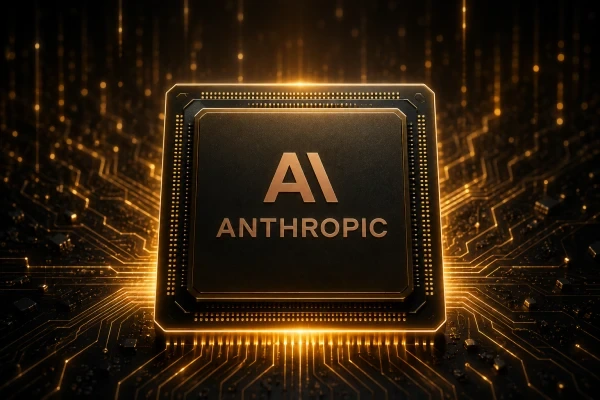
Anthropic Starts Building Its Own AI Chips to Power Claude
-

- by THEFLGHT,
- August 05, 2026
- in Artificial-Intelligence
Anthropic is making a major move into artificial intelligence hardware, confirming that it is building an in-house team to design custom chips specifically for its Claude AI models. The decision marks a significant change for the company, which has relied heavily on hardware supplied by Nvidia, Google, Amazon Web Services and AMD as demand for Claude continues to grow.
Anthropic says it plans to co-design its future hardware and AI models so the two can work together more efficiently, potentially giving the company greater control over the computing infrastructure required to train and operate increasingly powerful AI systems.
The announcement comes during a period when the availability of advanced AI chips has become one of the biggest constraints facing the technology industry. AI companies are spending billions of dollars securing computing capacity because training frontier models and serving millions of users requires enormous amounts of specialized hardware.
Anthropic has already signed major agreements with multiple chip and cloud providers, but the company now appears determined to develop additional hardware capabilities of its own rather than depending entirely on external suppliers.
Anthropic is recruiting engineers with experience in chip design for what it calls a custom silicon team. The company has not announced when its first internally designed processor will be completed, and it has not said that it intends to manufacture the chips itself. Instead, the immediate goal is to develop hardware designed around the specific requirements of Claude and Anthropic's AI workloads.
The strategy is becoming increasingly common among major AI companies. Google has spent years developing its Tensor Processing Units, or TPUs, which are specifically optimized for artificial intelligence workloads.
Meta is developing its MTIA accelerators, while OpenAI has also moved toward custom silicon through a partnership with Broadcom. Anthropic's decision shows that AI companies increasingly see specialized hardware as a strategic advantage rather than simply an infrastructure expense.
For Anthropic, the biggest potential benefit is efficiency. General-purpose AI accelerators are designed to handle a wide range of workloads, while custom processors can be optimized around the exact operations required by a particular model. By designing hardware and software together, Anthropic could potentially improve performance, reduce energy consumption and lower the cost of running Claude at large scale.
That could become increasingly important as AI models become more capable. Claude is being used for software development, research, business automation, cybersecurity and other workloads that can require large amounts of computing power. As customers use AI agents for longer and more complicated tasks, the amount of computing required to serve those requests can increase substantially.
The move could also strengthen Anthropic's position in the increasingly competitive AI market. OpenAI, Google, Meta and other companies are all investing heavily in infrastructure because access to computing capacity has become closely connected to the ability to train and deploy advanced models.
Having more control over hardware could give Anthropic another way to improve the economics of Claude while continuing to use external suppliers where appropriate.
Anthropic is not abandoning those suppliers, however. The company is maintaining a multi-chip strategy and continues to work with Amazon Web Services, Google, Nvidia and AMD.
That approach gives Anthropic access to different types of computing infrastructure instead of relying on a single hardware platform. It also reduces the risk that a shortage from one supplier could prevent the company from expanding its AI services.
The announcement is particularly significant for Nvidia. Nvidia currently dominates the market for high-performance AI accelerators, and its GPUs have become the foundation of many of the world's largest AI data centers.
Anthropic remains an Nvidia customer, but the decision to develop custom silicon demonstrates why major AI companies are increasingly looking for alternatives and complementary technologies.
Google could also benefit from Anthropic's continued demand for AI computing. Anthropic has already expanded its use of Google's AI chips, with the two companies working together to provide large amounts of computing capacity for Claude.
Anthropic's custom-chip initiative therefore does not necessarily mean it will move away from Google; instead, it could eventually give the company another layer of hardware alongside the infrastructure it already obtains from partners.
AMD is another important part of the equation. Anthropic recently agreed to purchase large amounts of AMD AI infrastructure, strengthening AMD's position in the market and giving Anthropic another alternative to Nvidia.
The growing number of suppliers involved in Anthropic's strategy illustrates how quickly the AI hardware market is changing as companies compete for enough computing power to meet demand.
The bigger story is that the AI competition is no longer just about which company can build the smartest model. Hardware is becoming a central part of the race. The cost of training models, running inference and operating autonomous AI agents can determine how quickly a company can expand and how much it can charge customers.
Custom chips could eventually allow AI companies to optimize every stage of that process. Instead of designing a model first and adapting it to whatever hardware is available, companies can increasingly design models and processors together. That approach could produce significant improvements in performance and efficiency, particularly for large-scale inference.
For Claude users, the impact may not be immediately visible. Anthropic has not announced a new Claude model or specific performance improvement connected to the custom-chip initiative. The project is still in its early stages, and building an advanced AI processor can take years of engineering, testing and manufacturing work.
Nevertheless, the decision signals where Anthropic believes the AI industry is heading. Computing capacity is becoming just as strategically important as model research, and companies that control more of their hardware stack could have an advantage when AI demand continues expanding.
The competition is likely to intensify. OpenAI is developing custom hardware with Broadcom, Google has its TPU ecosystem, Meta continues expanding its MTIA accelerator program, and Nvidia remains the dominant supplier of AI GPUs. Anthropic's entrance into custom chip design adds another major AI company to a semiconductor race that was once dominated primarily by traditional chipmakers.
The consequences could extend beyond Anthropic. If more AI companies successfully develop specialized processors, the market for AI computing could become more competitive and diversified. That could eventually put pressure on hardware prices, improve performance and give AI developers more options for building large-scale systems.
Anthropic's new chip team therefore represents much more than an internal hiring effort. It is a sign that the company wants greater control over one of the most important resources in the AI industry.
As Claude becomes more widely used and AI agents demand increasing amounts of computing power, the ability to design hardware specifically for those workloads could become one of Anthropic's most important competitive advantages.
The AI race is increasingly becoming a race for silicon, energy and computing infrastructure. Anthropic has already established itself as one of the leading companies in AI software. By moving into custom chip design, the Claude maker is now taking a step toward controlling more of the hardware that could determine how far its artificial intelligence systems can scale.





0 Comments:
Leave a Reply